
The Correction That Made Everything Worse
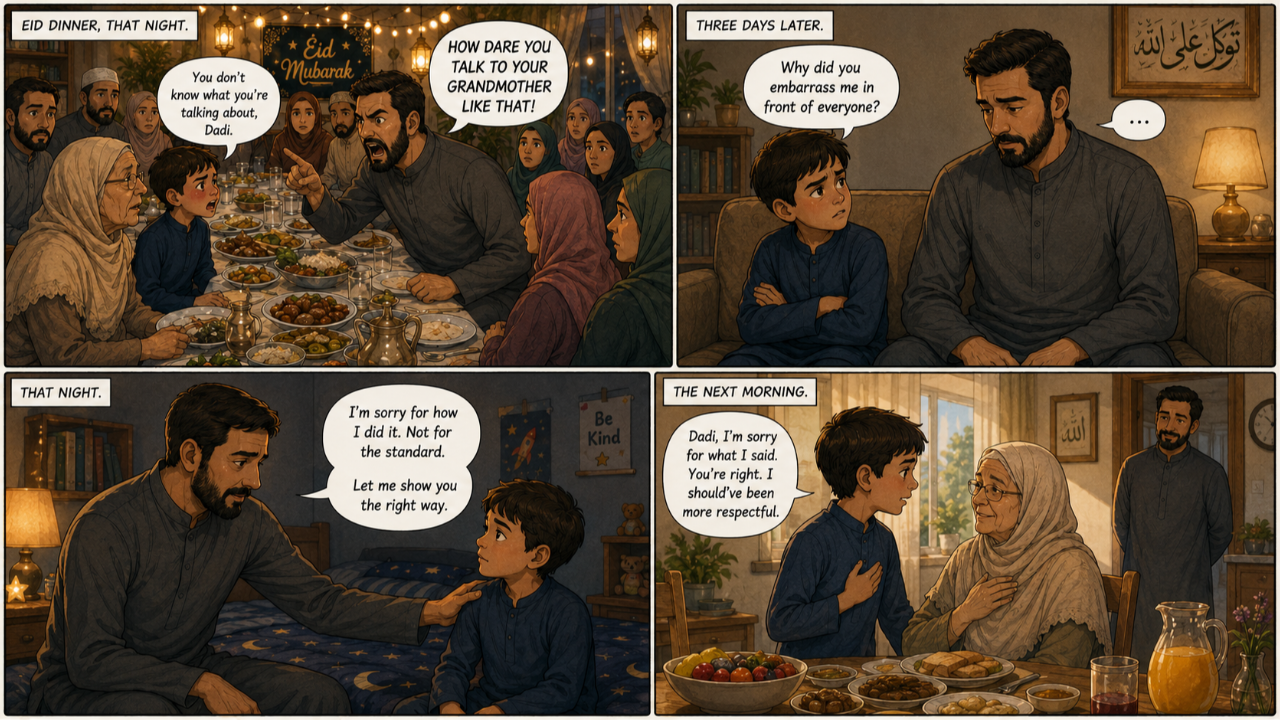
It was Eid dinner. Extended family. Thirty people in the house. Hassan's 8-year-old son Bilal said something disrespectful to his grandmother, in front of everyone. Hassan felt the eyes. He corrected Bilal loudly, sharply, immediately. In front of the room.
TEACHING
Bilal went red. Then went silent. Then disappeared into the back of the house for the rest of the evening.
Hassan's grandmother was defended. The room moved on. But three days later, Bilal still wasn't speaking to his father in the same way. And in a quiet moment, he said: "Why did you embarrass me in front of everyone?"
Hassan had been asking himself the same question.
The correction itself was warranted. The behavior was not acceptable. But the method, public, immediate, sharp, had done something that no correction should ever do: it had damaged the relationship more than it had redirected the behavior.
In the OMP framework, the Coach pillar is not about whether to correct. It is about how to correct so that the les...
She Told Her Friend First. Here's Why.
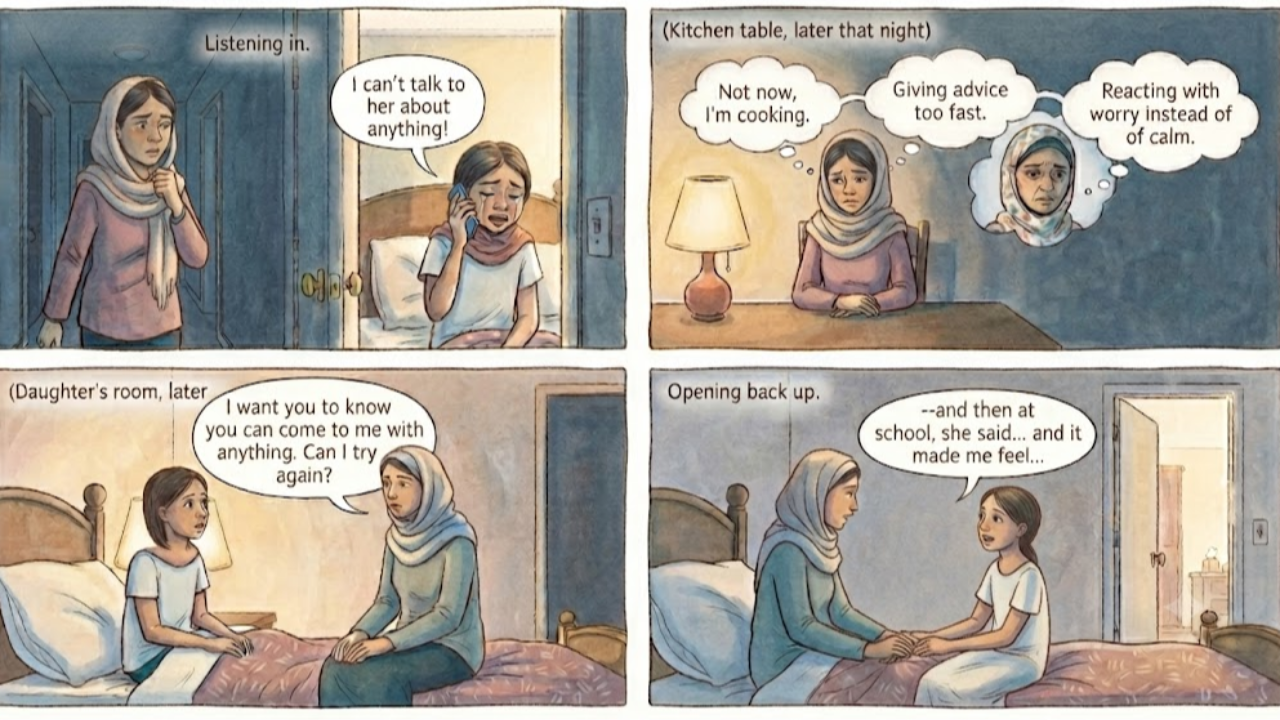
Aisha found out by accident. Her 10-year-old daughter Zainab had been being bullied, subtle things, the kind that don't leave marks but do leave damage. She'd been carrying it for almost a month. Aisha found out because she overheard a phone call Zainab was having with her classmate Reem.
TEACHING
Aisha's first reaction was hurt. Her second was guilt. Her third, the one that actually led somewhere useful, was curiosity. Why Reem? What did Reem have that made Zainab feel safe talking to her?
She didn't confront Zainab. She thought about it for two days. She replayed the last month in her mind, looking for the moments when Zainab had tried to come to her and been turned away, not rejected outright, but effectively closed.
She found them.
The evening Zainab started telling her something at dinner and she'd said "not now, I'm cooking." The time she'd given an immediate solution instead of sitting with the problem. The moment she'd reacted with worry instead of steadiness, and Zainab's...
What Your Kids Need to See You Do
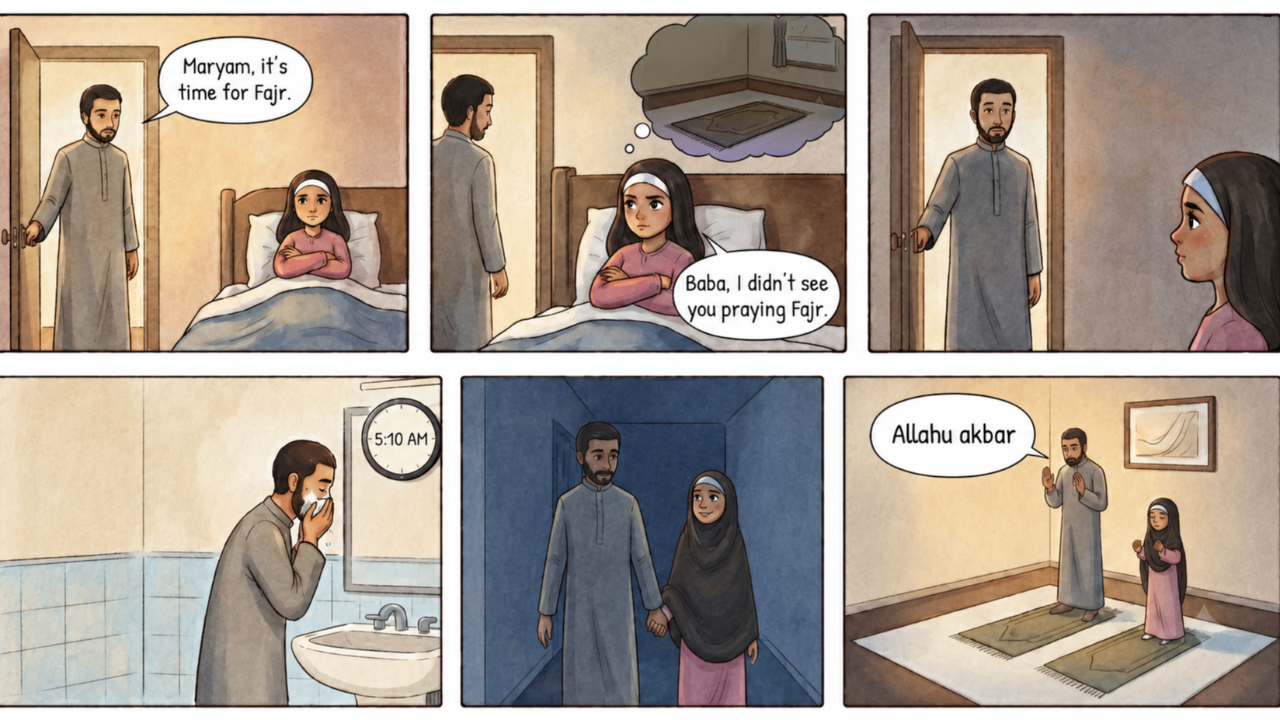
Umar had been telling his 9-year-old daughter Maryam to pray Fajr for six months. Every morning, the same conversation. Every morning, the same result. One Thursday, Maryam looked up at him and said, with the brutal honesty that only a 9-year-old can deliver: "Baba, I didn't see you pray Fajr."
TEACHING
He opened his mouth. Then closed it.
He could not remember the last time he had prayed Fajr in the masjid. Or made it a non-negotiable at home. Or shown Maryam, in practice, that Fajr was something worth getting up for.
He had been teaching her to do something he was inconsistently doing himself.
The gap between what parents say and what parents do is the most important gap in parenting. Children don't measure their parents by their words. They measure them by their patterns. And what they observe in the patterns of a parent becomes their internal blueprint for what a Muslim adult looks like.
In the OMP framework, Celebrity is not about being admired. It is about being worth follo...
The Day I Gave My 7-Year-Old a Real Job
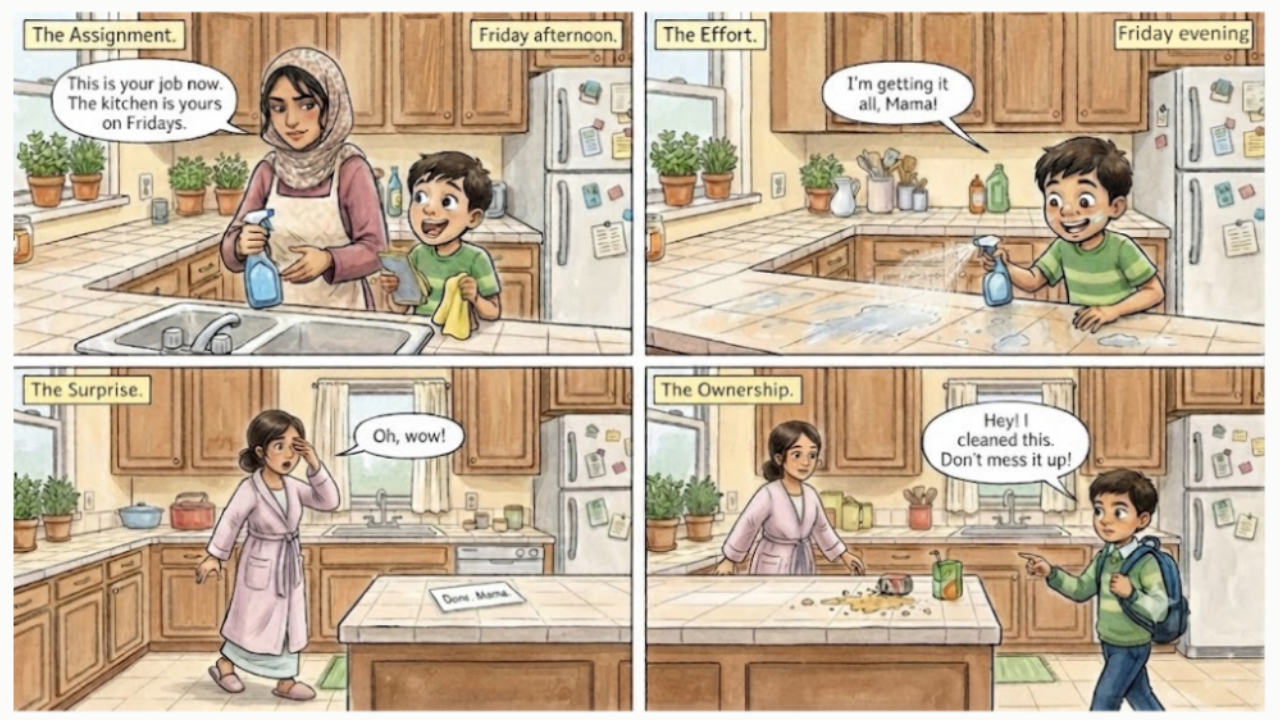
Fatima had been cleaning the kitchen alone for years. Her children were always around, technically available, theoretically capable, but somehow the kitchen was always her responsibility. One Friday morning, she handed her 7-year-old son Adam a spray bottle and a rag and said: "This is your job now. The kitchen is yours on Fridays."
TEACHING
He looked at her like she'd handed him a diploma.
The first Friday was imperfect. He missed spots. He sprayed too much. He was proud of himself anyway. The second Friday was slightly better. By the fourth Friday, he was doing it unprompted, before she even woke up, and leaving her a note on the counter that said "Done, Mama."
In three weeks, something had shifted in him. He walked through the kitchen differently. With a kind of ownership. He'd point out messes to his siblings: "I cleaned this. Don't mess it up." He started noticing when other things in the house needed attention.
Fatima hadn't just given him a chore. She had given him a role.
...The Lesson I Should Have Taught First
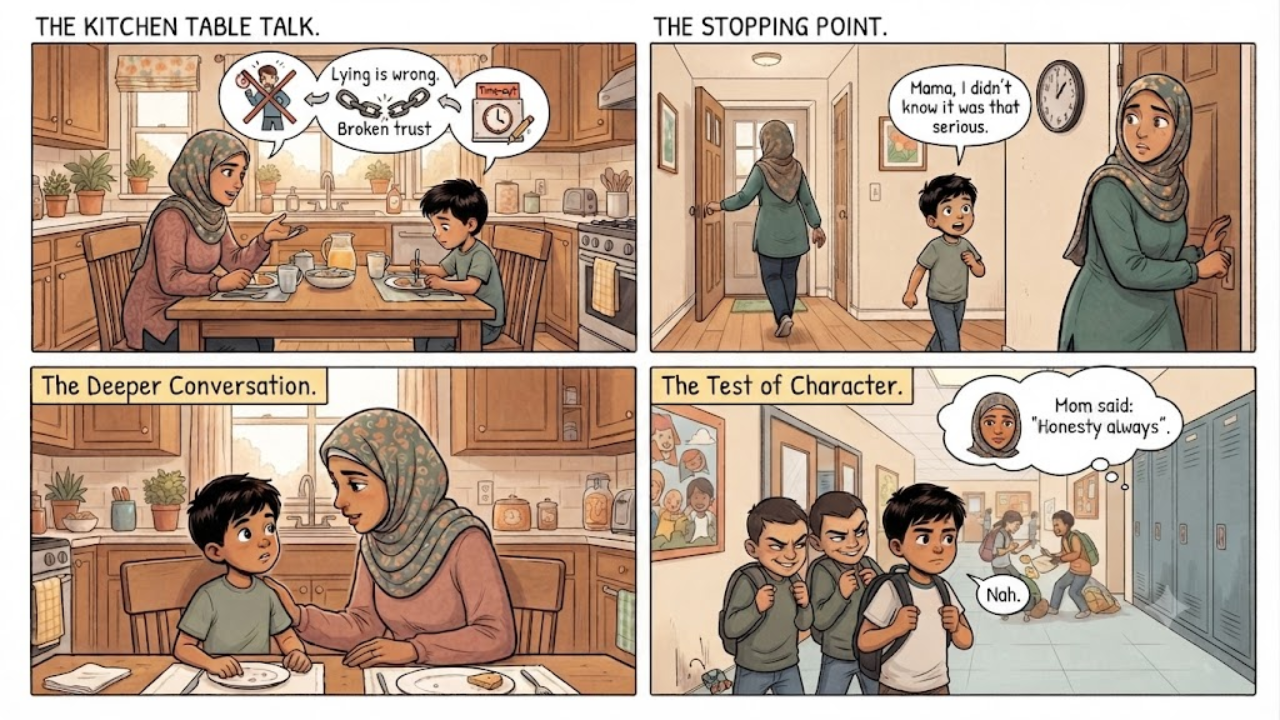
Umm Zaid caught her 8-year-old son in a lie. Not a big one, the kind children tell about whether they brushed their teeth, whether they finished their homework. But it was the third time that week. And she sat down that night to have a serious talk about honesty.
TEACHING
She explained that lying was wrong. She told him it broke trust. She referenced what Allah says about honesty. She gave consequences.
Her son sat there and nodded through all of it.
And then, as she was walking out, he said something that stopped her in the hallway: "Mama, I didn't know it was that serious."
She stood there for a moment. And then she realized: she had never told him.
She'd told him not to lie. She'd corrected him when he did. But she had never sat down and actually taught him, why honesty matters, what it means in Islam, what it feels like to be in a relationship built on trust versus one corroded by deception.
She had assumed he knew. He didn't.
In the OMP framework, Educate is the second of ...
Five Minutes on the Floor Changed Everything
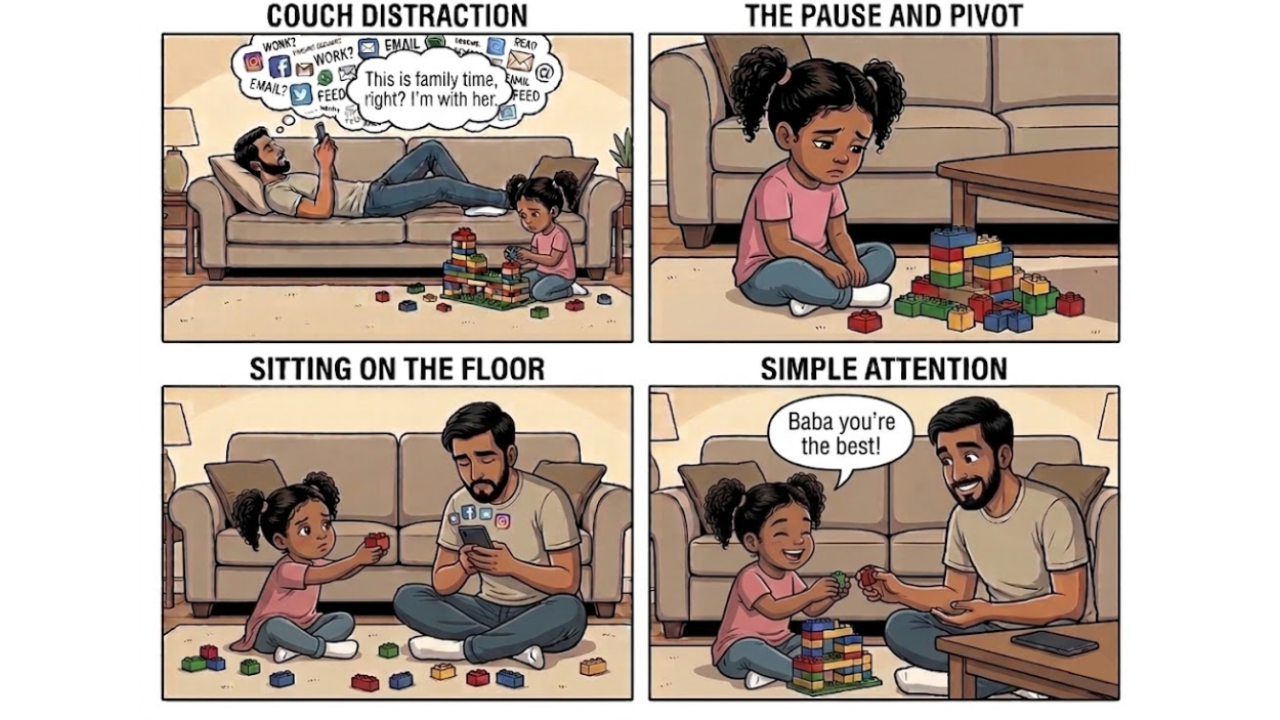
Ibrahim had been on the couch for 45 minutes.
His 5-year-old daughter Safiya was on the floor three feet away. Building LEGO.
He'd glanced at her occasionally. Mostly he was on his phone.
He told himself this counted as family time.
The Moment He Put the Phone Down
Something made him stop. He's still not sure what.
Maybe the way she was narrating her build quietly to herself. Maybe just a feeling.
He put the phone down. Got off the couch. Sat on the floor next to her.
He didn't say anything. She kept building.
About two minutes in, she wordlessly handed him a piece, the specific piece she needed him to hold while she clicked another in.
He held it. She built.
For three minutes, no agenda, no plan, no teachable moment.
Just together.
When she looked up and said, "Baba, you're the best",
He hadn't done anything exceptional.
He just sat on the floor.
That's Exactly the Point
In the OMP framework, Engage is the first of the three E's.
And what it means is deceptively simp...
I Yelled. Then I Sat in the Car.
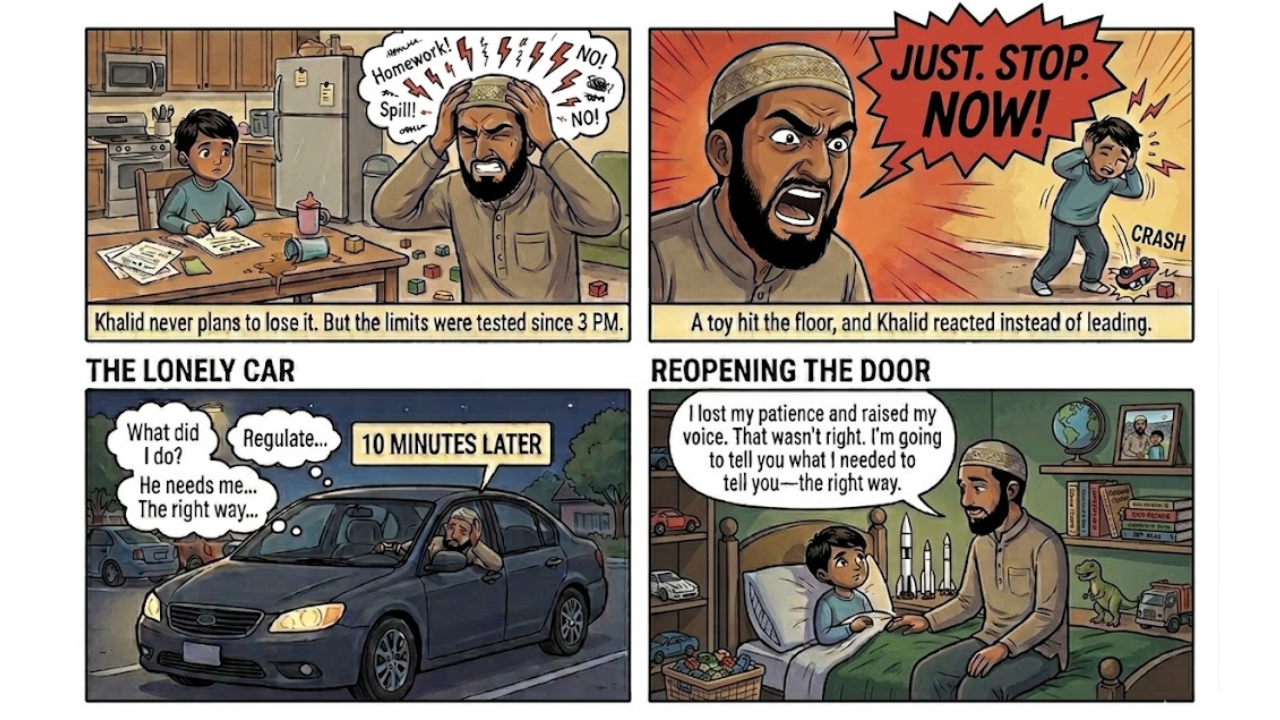
Khalid didn't plan to lose it.
He never does.
It was a Tuesday evening.
Homework battles. A spilled drink. A 6-year-old who had been testing every limit since 3 PM.
Then a toy hit the floor.
And Khalid heard himself yell in a way he is not proud of.
He sent his son to his room. Then walked outside. Got in the car. And sat there for 10 minutes.
He was regulating.
He was doing—alone, in a parking space—what he should have done before he responded:
Getting himself back into a state where he could lead instead of react.
The Real Problem
The problem wasn't that Khalid got angry. Anger is human.
The problem was that he skipped the pause.
And now his son was in his room, not learning anything useful. Just waiting for it to be over.
The First Rule of the Coach Pillar
In the OMP framework, the third pillar is Coach.
And the first rule of coaching is this:
You cannot lead a situation you are not regulated in.
A yell communicates volume.
A calibrated, calm correction communicat...
The Night She Didn't Come to Me
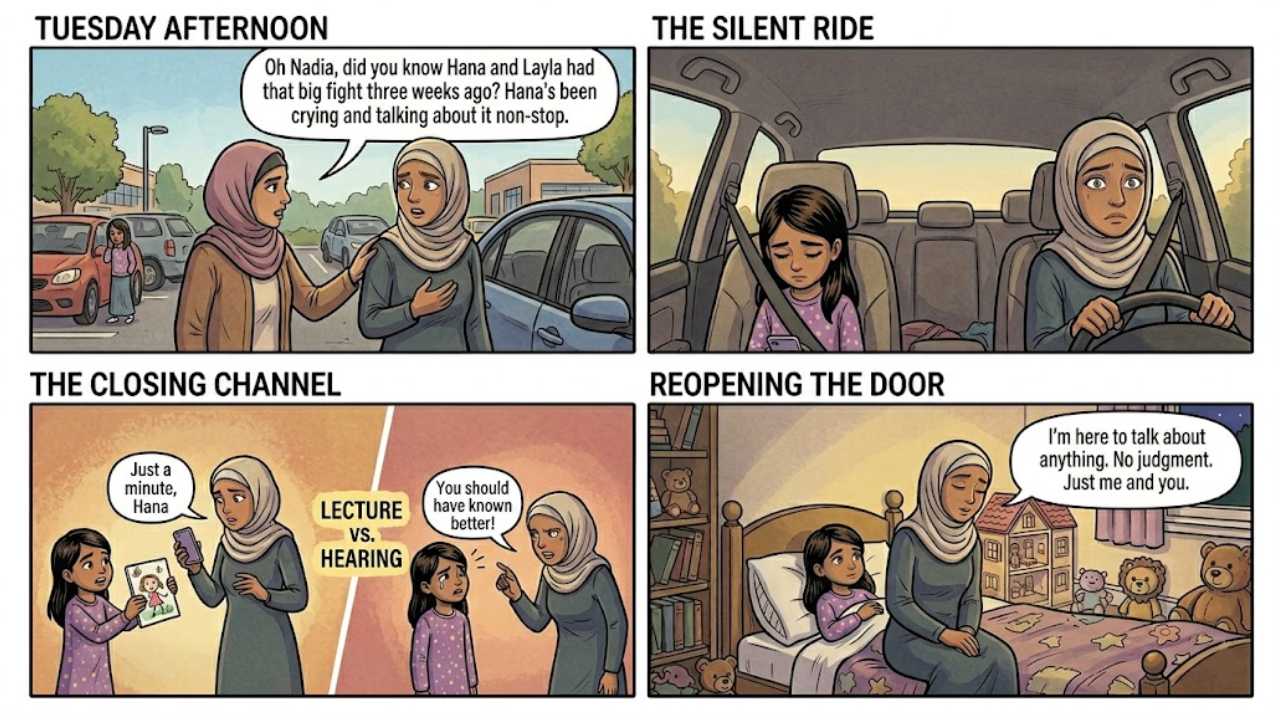
Nadia found out on a Tuesday.
Not from Hana.
From Layla's mother. In a parking lot. After school pickup.
Hana had been struggling for three weeks. A falling-out with her best friend. The kind that feels catastrophic at 9 years old.
She had cried. Lost sleep. Talked about it endlessly.
With Layla. Not with her mother.
The Drive Home
Nadia drove home in near silence. Hana was in the backseat.
She didn't say anything about it. She just kept thinking:
She had three weeks of this. And she didn't come to me.
When did that happen?
The Channel Doesn't Close All at Once
It's a question that cuts deep.
Because it forces parents to face something uncomfortable:
The safe channel doesn't close overnight.
It closes slowly. One interaction at a time.
It closes the first time a child shares something and gets lectured instead of heard.
It closes when honesty leads to punishment instead of understanding.
It closes when a parent is too distracted to notice their child trying to open a ...
The Parent Who Shows Up Anyway
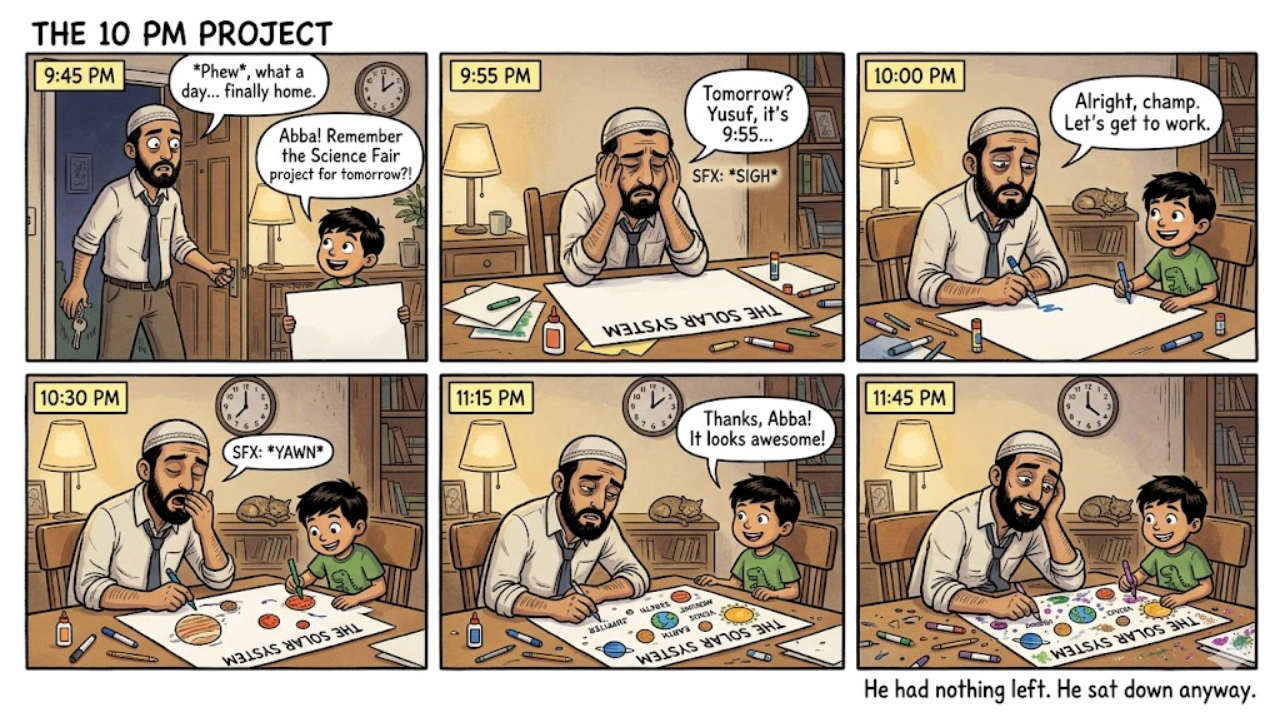
The Parent Who Shows Up Anyway
Tariq didn't plan for it.
He walked through the door exhausted.
10-hour shift. An hour of traffic. Nothing left in the tank.
His 7-year-old son Yusuf was in the kitchen. Waiting.
Science project due tomorrow. He'd been asking for a week.
The Moment That Actually Matters
Tariq had two choices.
He could say, "I'm exhausted. Tomorrow."
Or he could sit down.
He sat down.
Not because he felt like it. Not because he had energy to spare.
Because he understood something it took him years to figure out:
Authority is not built in the big moments.
It's built in the small ones.
The ones where you're tired. The ones where showing up costs you something.
What Celebrity Actually Means
In the OMP framework, we call the first pillar Celebrity.
Not fame. Not perfection.
Celebrity is the earned status of being someone your child genuinely looks up to.
Someone they want to follow. Someone they come to first when something goes wrong.
It is not given by a...
The Day Hassan Realized the World Was Teaching His Son Faster Than He Was
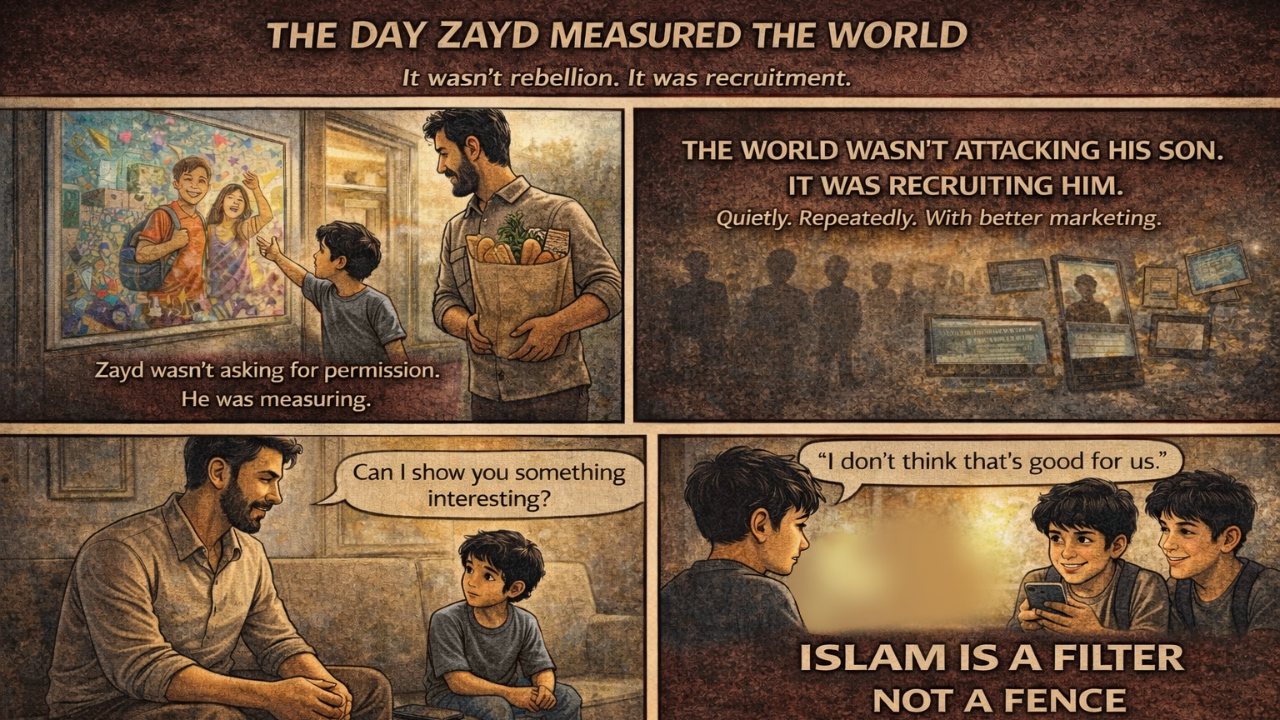
Zayd didn’t say it angrily.
That’s what scared Hassan.
They were walking out of the grocery store when Zayd pointed at a poster. Music. Bright colors. A smiling face.
“That looks fun,” Zayd said.
Then, casually:
“Why can’t we do stuff like that?”
Hassan smiled automatically.
But inside, something dropped.
Because Zayd wasn’t asking for permission.
He was measuring.
And Hassan suddenly understood the danger.
The world wasn’t attacking his son.
It was recruiting him.
The World Never Stops Planting Seeds
Modern parents think danger comes loudly.
It doesn’t.
It comes softly.
Repeatedly.
With better marketing.
Your child is surrounded by:
- Images
- Messages
- Values
- Rewards
All of them answering one question for your child:
“Who should I be?”
If you don’t answer that question clearly, the dunya will.
Why This Is Happening (And Why It’s Not Your Fault)
Between ages 3 and 10, you are not competing on logic.
You are competing on influence.
This is where the first C matt...

