
The Day Fatima Quit Asking Her Daughter to Pray
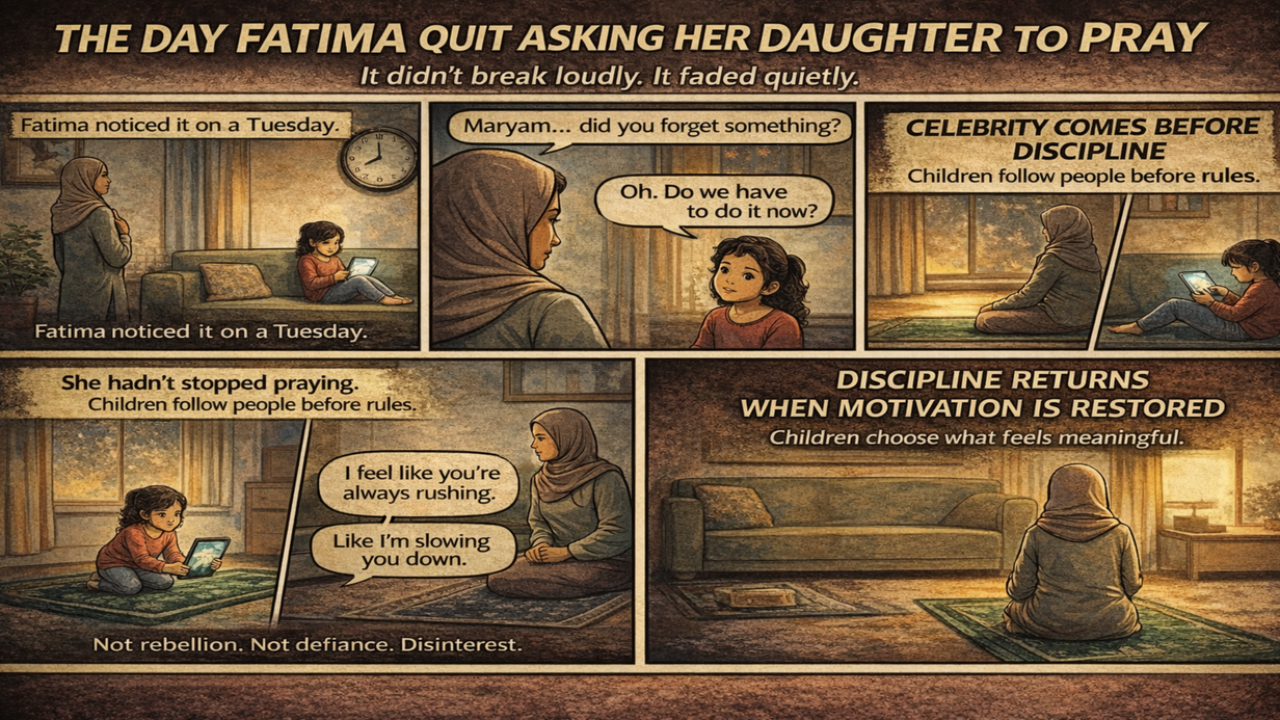
Fatima noticed it on a Tuesday.
It wasn’t loud.
It wasn’t dramatic.
It was quiet.
Maryam, her eight-year-old daughter, used to remind her about salah.
“Mama, is it time yet?”
“Can I put the mat next to yours?”
That Tuesday, Maghrib came and went.
Fatima glanced at the clock.
Then at Maryam.
Nothing.
Maryam was on the couch, legs tucked under her, scrolling through a children’s app. Her face was calm. Content. Unbothered.
Fatima felt a tightening in her chest.
She cleared her throat.
“Maryam… did you forget something?”
Maryam looked up. Blank.
“Oh. Do we have to do it now?”
Not rebellion.
Not defiance.
Disinterest.
And that’s when Fatima realized something terrifying.
Her daughter hadn’t stopped praying.
She had stopped caring.
Discipline Didn’t Break. Motivation Did.
Most parents panic at this point.
They clamp down.
- “No screen until you pray.”
- “If you don’t pray, there are consequences.”
- “Because Allah said so.”
And sometimes it works.
Short term.
But what Fatima felt in that moment wasn’t fear of disobedience.
It was fear of emptiness.
Because a child who obeys without motivation will eventually obey someone else.
Celebrity Comes Before Discipline
Here is the uncomfortable truth:
Children do not follow rules first.
They follow people.
Between ages 3 and 10, you are not just a parent.
You are the Celebrity.
Your approval is currency.
Your attention is oxygen.
Your reaction defines what matters.
Maryam didn’t stop praying because prayer stopped being important.
She stopped because something else had become more pleasurable.
More engaging.
More rewarding.
More present.
And Fatima hadn’t noticed the shift.
Motivation Is Built on Pain and Pleasure
Every human moves the same way.
Toward pleasure.
Away from pain.
Maryam used to associate prayer with:
- Warmth
- Togetherness
- Mama’s presence
- Feeling grown up
Now she associated it with:
- Interruption
- Pressure
- Being pulled away from fun
- A task to finish
Prayer hadn’t changed.
The emotional association had.
And motivation collapsed quietly.
The Question That Changed Everything
That night, Fatima didn’t lecture.
She didn’t threaten.
She asked one question.
“Maryam… can I ask you something?”
Maryam nodded.
“How does praying make you feel lately?”
Maryam hesitated. Then shrugged.
“I don’t know. I feel like you’re always rushing. Like I’m slowing you down.”
That sentence hit harder than rebellion ever could.
Fatima realized something in that moment.
She hadn’t lost discipline.
She had lost Engage.
Engage Is Not More Time. It’s Better Timing.
Engage does not mean:
- Long lessons
- Perfect routines
- Doing everything right
Engage means intentional presence at the moment of meaning.
Fatima made one change.
At salah time, she stopped multitasking.
No phone.
No rushing.
No correcting.
She sat first.
She laid out the mat slowly.
She waited.
Maryam watched.
Children always do.
From Celebrity to Confidant
The next day, Fatima tried again.
Before prayer, she asked:
“What do you think Allah feels when we pray together?”
Maryam thought.
“Happy… because we’re choosing Him?”
That was it.
No lecture could compete with that moment.
Because Maryam wasn’t being commanded.
She was being included.
That’s how you become a Confidant.
Discipline Returns When Motivation Is Restored
Within a week, something shifted.
Maryam began reminding Fatima again.
Not because she had to.
Because she wanted to.
Discipline didn’t come from fear.
It came from ownership.
That’s the third E.
Empower.
A child who chooses Islam is stronger than a child who is forced into it.
What Most Parents Get Wrong About Motivation
They think motivation is something you install.
It’s not.
Motivation is something you model.
Children don’t listen to what you say is important.
They watch what you slow down for.
The Window You’re In Right Now
If your child is between 3 and 10, listen carefully.
Right now:
- You are still the Celebrity
- You can still reclaim motivation
- You can still shape association
But this window does not stay open forever.
Soon:
- Friends become the celebrities
- Screens become the coaches
- The dunya becomes the confidant
Unless you install the framework now.
The Invitation
The Cost of Waiting Is Invisible Until It’s Permanent
Your child is not unmotivated.
They are being motivated elsewhere.
Right now:
- YOU are still the Celebrity whose attention shapes effort.
- YOU can still become the Confidant they open up to.
- YOU can still Coach discipline through meaning, not force.
But motivation follows pleasure.
And the world is very good at making itself pleasurable.
If you wait, discipline will feel harder.
Connection will feel thinner.
Correction will feel like conflict.
We’ve developed a clear roadmap to help parents master:
- The Three C’s: Celebrity, Confidant, Coach
- The Three E’s: Engage, Equip, Empower
We send one high-impact, actionable lesson every week to help you build motivation before discipline breaks.
Don’t wait until obedience turns into resistance.
👉 JOIN THE OUTSTANDING MUSLIM PARENTS NEWSLETTER
(Join 5,000+ parents learning how to lead with clarity instead of control.)

