
The Day Hassan Realized the World Was Teaching His Son Faster Than He Was
Zayd didn’t say it angrily.
That’s what scared Hassan.
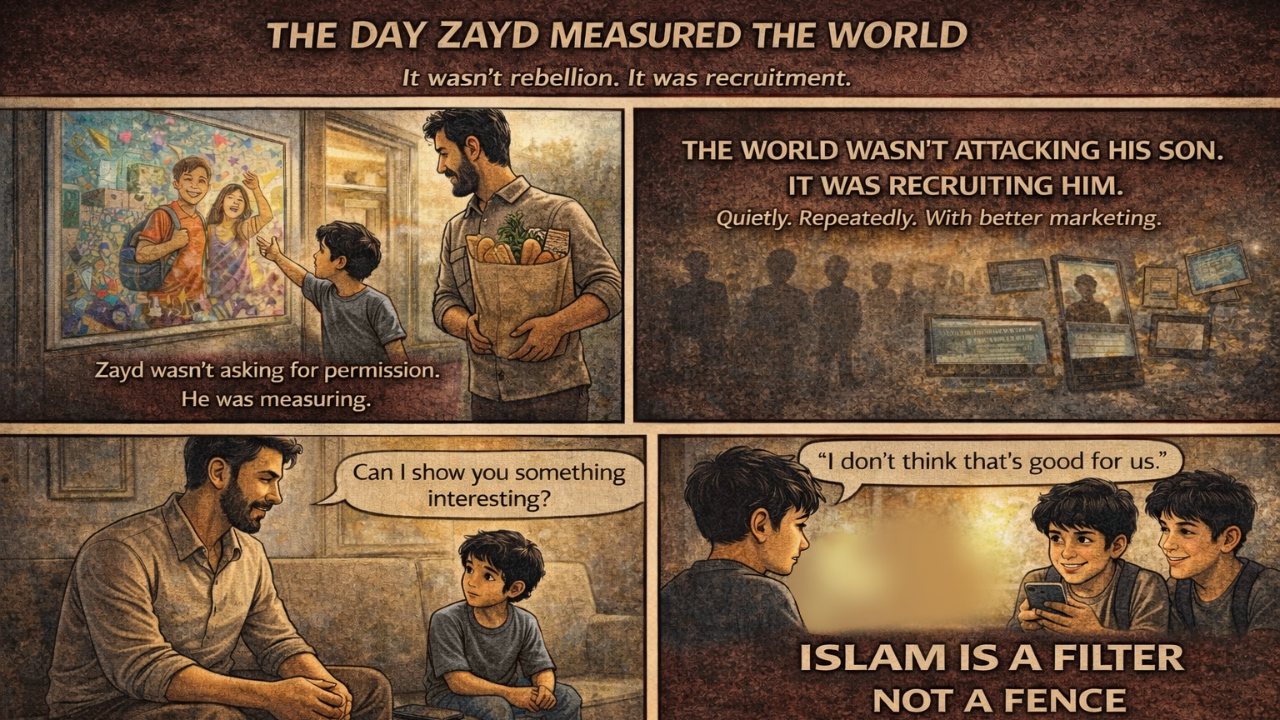
They were walking out of the grocery store when Zayd pointed at a poster. Music. Bright colors. A smiling face.
“That looks fun,” Zayd said.
Then, casually:
“Why can’t we do stuff like that?”
Hassan smiled automatically.
But inside, something dropped.
Because Zayd wasn’t asking for permission.
He was measuring.
And Hassan suddenly understood the danger.
The world wasn’t attacking his son.
It was recruiting him.
The World Never Stops Planting Seeds
Modern parents think danger comes loudly.
It doesn’t.
It comes softly.
Repeatedly.
With better marketing.
Your child is surrounded by:
- Images
- Messages
- Values
- Rewards
All of them answering one question for your child:
“Who should I be?”
If you don’t answer that question clearly, the dunya will.
Why This Is Happening (And Why It’s Not Your Fault)
Between ages 3 and 10, you are not competing on logic.
You are competing on influence.
This is where the first C matters most.
Celebrity.
You are the sun in your child’s solar system.
Or you’re not.
If the world feels more exciting…
More confident…
More certain…
Then your child naturally leans there.
Not because Islam is weak.
But because attention creates authority.
Zayd Didn’t Doubt Islam. He Lacked a Filter.
Hassan replayed the moment that night.
Zayd wasn’t rejecting Islam.
He simply didn’t know how to use it.
Islam wasn’t functioning as a filter in his mind.
It wasn’t answering questions like:
- “Is this good for me?”
- “Does this align with who I am?”
- “What does Allah say about this choice?”
Without a filter, children default to whatever feels good now.
That’s not rebellion.
That’s wiring.
The Mistake Most Good Parents Make
They assume identity forms later.
In teenage years.
After “understanding.”
That’s false.
Identity forms before arguments.
It forms through:
- What we slow down for
- What we explain
- What we contrast clearly
- What we allow to remain vague
Hassan realized something painful.
He taught Zayd what Islam is.
But not why it protects him.
Engage Before the World Wins the Narrative
The next day, Hassan changed one thing.
He didn’t lecture.
He didn’t warn.
He Engaged.
When Zayd sat down after school, Hassan sat with him.
No phone.
No multitasking.
“Zayd,” he said, “can I show you something interesting?”
That sentence changed everything.
Islam Makes Sense When You Compare It Honestly
Hassan didn’t romanticize Islam.
He contrasted it.
He talked about:
- Societies before Islam
- Pleasure without limits
- Desire without discipline
- Freedom that eventually enslaves
Then he compared it to today.
Same impulses.
New packaging.
Zayd leaned in.
Because children don’t need censorship.
They need clarity.
Confidant Is Built When You Tell the Truth Calmly
Hassan didn’t pretend Islam was easy.
He said:
“Islam doesn’t stop you from wanting things.
It teaches you when wanting becomes harmful.”
That mattered.
Because Zayd wasn’t being talked at.
He was being talked with.
That’s the second C.
Confidant.
From Understanding to Ownership
Then Hassan did the most important thing.
He stopped deciding for Zayd.
He started asking Zayd to think.
“What happens if everyone does whatever they want?”
“What happens when nobody says no to desire?”
“What do you think Allah is protecting us from?”
Zayd answered slowly.
Carefully.
That was the third E.
Empower.
The Filter Installed Quietly
Weeks later, Hassan overheard something.
Zayd was with friends.
Someone suggested something questionable.
Zayd paused and said:
“I don’t think that’s good for us.”
No father present.
No threat.
No rule.
Just a filter.
That’s Islamic identity.
This Window Is Closing Faster Than You Think
Right now:
- You are still the Celebrity
- You can still become the Confidant
- You can still coach thinking, not just behavior
But the world is relentless.
And it never takes breaks.
Identity Is Being Installed Right Now
Your child is already learning who to be.
Right now:
- The dunya is offering answers.
- Culture is offering identity.
- Pleasure is offering direction.
If Islam does not become their filter, something else will.
You are still in the critical window where:
- YOU are the Celebrity they borrow certainty from.
- YOU can become the Confidant they trust with questions.
- YOU can Coach thinking, not just behavior.
But this window does not stay open forever.
We built Outstanding Muslim Parents to give you:
- A clear identity-building framework
- Weekly guidance you can actually use
- Tools to help your child choose Islam when you’re not there
One lesson per week.
Designed for real families.
Built for today’s pressures.
Don’t let the world define your child first.
👉 JOIN THE OUTSTANDING MUSLIM PARENTS NEWSLETTER
(Join 5,000+ parents learning how to lead with clarity instead of control.)

