
The Afternoon Omar Asked a Question That Changed Everything
The Afternoon Omar Asked a Question That Changed Everything
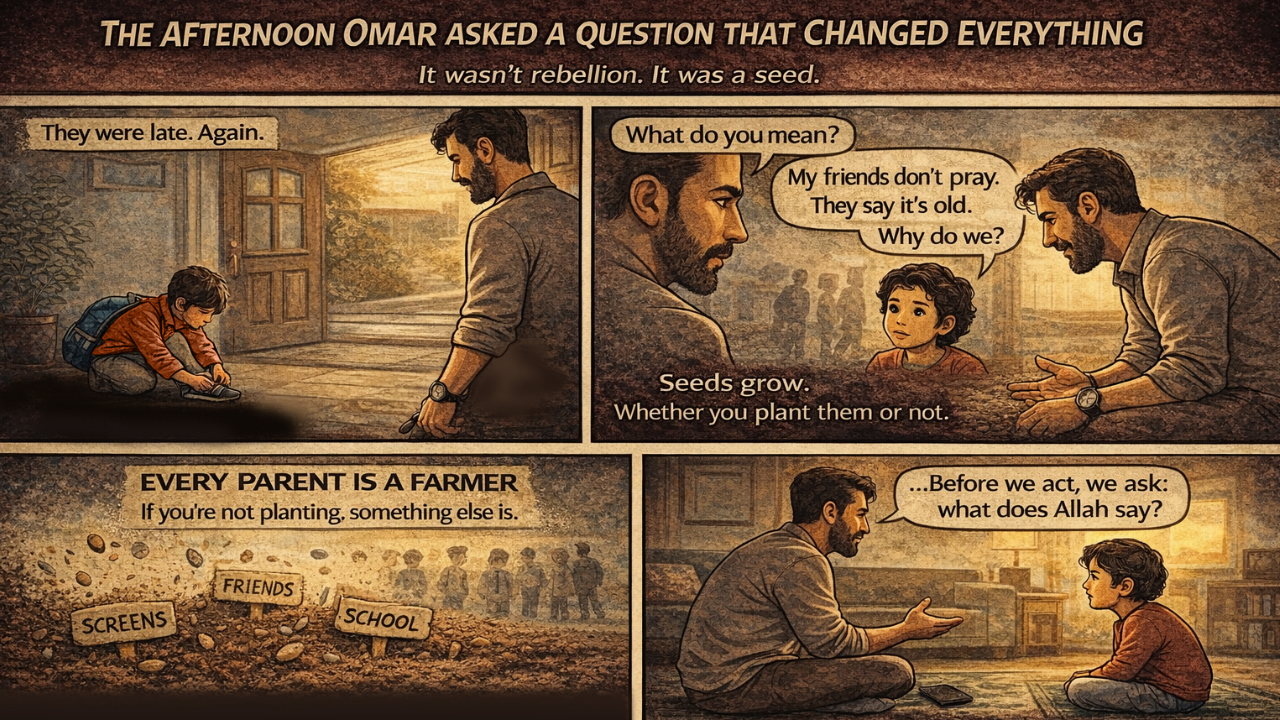
Omar was tying his shoes when the question came.
“Baba… why don’t we do what they do?”
His father, Kareem, froze.
They were late. Again.
School pickup traffic. A work call waiting. His phone buzzing in his pocket.
“What do you mean?” Kareem asked, distracted.
Omar shrugged. “My friends don’t pray. They say it’s old. Why do we?”
That was the moment.
Not because the question was hard.
But because Kareem realized something terrifying.
This wasn’t a rebellion.
It was a seed.
And seeds grow. Whether you plant them or not.
Every Parent Is a Farmer. Most Don’t Know What They’re Planting.
Children are not blank slates.
They are soil.
And soil is always receiving seeds.
From school.
From screens.
From friends.
From culture.
If you are not intentionally planting, something else already is.
That’s not fear-mongering.
That’s reality.
Celebrity Comes Before Identity
Between ages 3 and 10, your child does not form beliefs from arguments.
They form beliefs from you.
You are the Celebrity.
Your reactions teach importance.
Your silence teaches indifference.
Your tone teaches value.
When Kareem didn’t immediately answer Omar’s question, Omar wasn’t testing Islam.
He was testing his father’s confidence in it.
Children don’t ask questions to debate.
They ask to see if you stand firm.
The Most Important Seed You Will Ever Plant
Many parents say, “I want my child to be successful.”
But success means different things to different homes.
Grades.
Careers.
Status.
Islam defines success clearly.
Jannah.
And Allah gave parents a gift most don’t think about.
A righteous child who prays for you… after you are gone.
That seed doesn’t get planted in teenage years.
It gets planted now.
Quietly.
Daily.
The Problem With Outsourcing the Farm
Kareem did what many parents do.
He assumed:
- Islamic school would handle it
- Sunday programs would reinforce it
- Being “around Muslims” would protect it
But proximity is not planting.
And schooling is not education.
Identity is not absorbed by osmosis.
It is modeled, explained, and reinforced.
At home.
Engage: Where Seeds Actually Take Root
That night, Kareem changed his approach.
He didn’t lecture Omar.
He didn’t quote.
He sat next to him.
“Omar,” he said, “can I tell you a story?”
And for the first time that day, Kareem put the phone down.
That was Engage.
Not long.
Not dramatic.
Intentional.
Teaching Through Contrast, Not Fear
Kareem didn’t start with rules.
He compared worlds.
“Before Islam,” he said, “people chased whatever felt good. Drinking. Fame. Pleasure.”
Omar nodded. “Like today?”
Kareem smiled. “Exactly like today.”
That was the moment Omar leaned in.
Children don’t need protection from truth.
They need context.
Islam didn’t come to erase human desire.
It came to discipline it.
Confidant Is Built Through Honesty
Kareem didn’t pretend Islam was always easy.
He didn’t dramatize doom.
He didn’t sigh and say, “The world is finished.”
He spoke calmly.
“Islam gives us a filter,” he said.
“Before we act, we ask: what does Allah say?”
Omar thought about that.
“So… it’s like a rule before the rule?”
Exactly.
That’s how a child becomes thoughtful, not compliant.
The Seeds You Must Never Plant
Many parents unintentionally poison the soil.
They associate Islam with:
- Anger
- Yelling
- Disappointment
- Tension
When “Ya Allah” only comes out in frustration, children learn something dangerous.
They learn to associate faith with negativity.
Seeds grow.
Even bad ones.
Coach Through Calm, Not Chaos
The next morning, Omar forgot his bag.
Kareem felt the irritation rise.
Old habit would have yelled.
Instead, he paused.
He got quiet.
“Omar,” he said calmly, “what do we do when we forget?”
Omar blinked. He wasn’t used to that tone.
“I fix it?” he said.
“Exactly.”
That was a pattern interrupt.
And children notice those.
Standards Are Seeds Too
Strong homes don’t negotiate values.
They model them.
When standards are clear early:
- Respect becomes normal
- Obedience feels natural
- Discipline feels safe
Later, those standards become internal.
That’s Empower.
The Question You Should Ask Tonight
Ask yourself honestly:
“What seeds is my child absorbing daily?”
And more importantly:
“Which ones am I planting on purpose?”
Because hope is not a strategy.
But frameworks are.
Every Day Is a Planting Day — Whether You’re Intentional or Not
Your child is growing.
Right now:
- Seeds are being planted by school.
- Seeds are being planted by screens.
- Seeds are being planted by culture.
The question is not if something will grow.
It’s what will grow.
You are still in the window where:
- YOU are the primary planter.
- YOU can shape character quietly.
- YOU can build roots that last beyond your presence.
But harvest never asks for permission.
We’ve created a weekly system to help Muslim parents:
- Plant the right seeds early
- Build iman without pressure
- Raise children who grow toward Islam naturally
One focused lesson per week.
Clear frameworks.
No overwhelm.
Don’t wait until you’re surprised by the harvest.
👉 JOIN THE OUTSTANDING MUSLIM PARENTS NEWSLETTER
(Join 5,000+ parents learning how to lead with clarity instead of control.)

