
The Lesson I Should Have Taught First
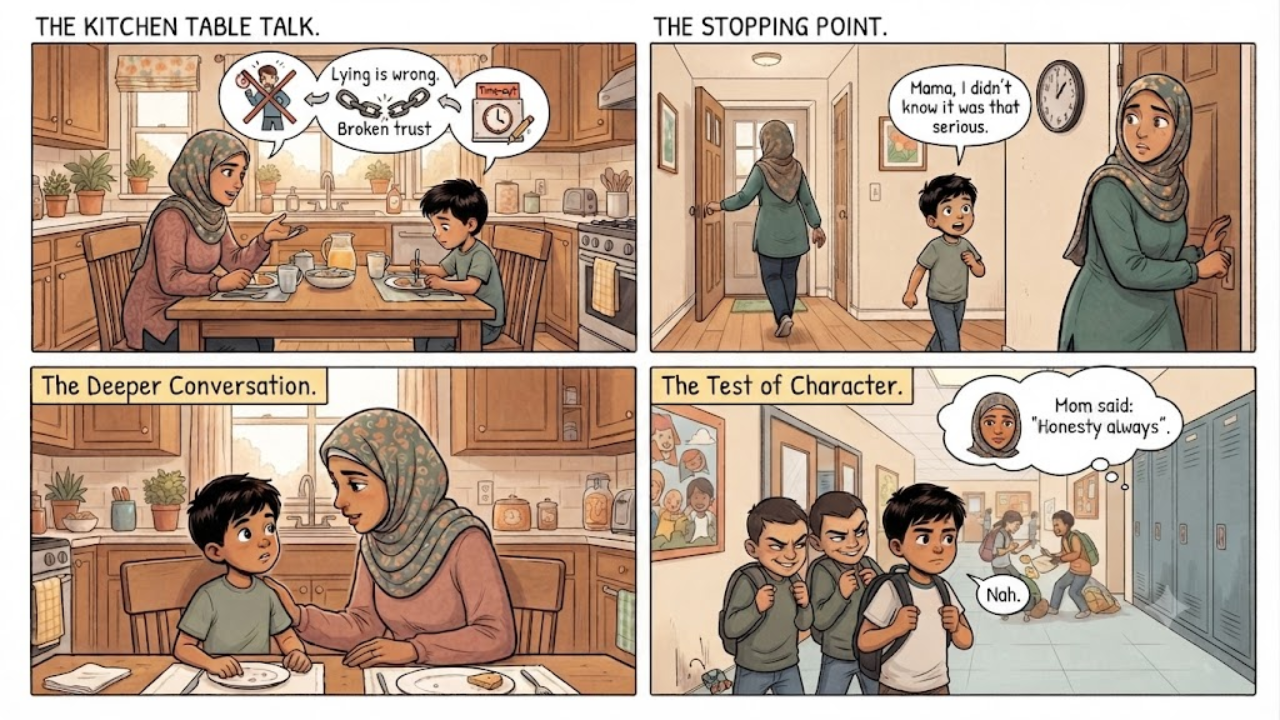
Umm Zaid caught her 8-year-old son in a lie. Not a big one, the kind children tell about whether they brushed their teeth, whether they finished their homework. But it was the third time that week. And she sat down that night to have a serious talk about honesty.
TEACHING
She explained that lying was wrong. She told him it broke trust. She referenced what Allah says about honesty. She gave consequences.
Her son sat there and nodded through all of it.
And then, as she was walking out, he said something that stopped her in the hallway: "Mama, I didn't know it was that serious."
She stood there for a moment. And then she realized: she had never told him.
She'd told him not to lie. She'd corrected him when he did. But she had never sat down and actually taught him, why honesty matters, what it means in Islam, what it feels like to be in a relationship built on trust versus one corroded by deception.
She had assumed he knew. He didn't.
In the OMP framework, Educate is the second of the three E's. And it is built on a foundational insight that changes how parents approach behavior: most children don't misbehave because they're bad. They misbehave because they haven't been taught.
Correction after the fact is not the same as teaching. Correction says: that was wrong. Teaching says: here is what is right, here is why it matters, here is what it looks like in a Muslim household, and here is who I want you to become.
The difference in outcomes is significant.
Children who are only corrected learn to avoid punishment. Children who are taught develop internal standards. And when a child has an internal standard rooted in Islamic values, not just parental rules, they carry it into rooms where you will never be present.
That night, Umm Zaid went back into her son's room. She said: "I told you that lying was wrong. But I didn't explain to you why it matters so deeply in Islam, and I should have." And then she taught him.
He never had to be corrected for lying in the same way again.
THIS WEEK'S APPLICATION
"This week, identify one behavior you've been correcting repeatedly. Then ask yourself: have I actually taught the principle behind it, or have I only addressed the behavior? Go teach the principle first. Do it in a calm moment, not a conflict."
👉 JOIN THE OUTSTANDING MUSLIM PARENTS NEWSLETTER
(Join 5,000+ parents learning how to lead with clarity instead of control.)
— Coach Nazir, Founder of Outstanding Muslim Parents

