
The Correction That Made Everything Worse
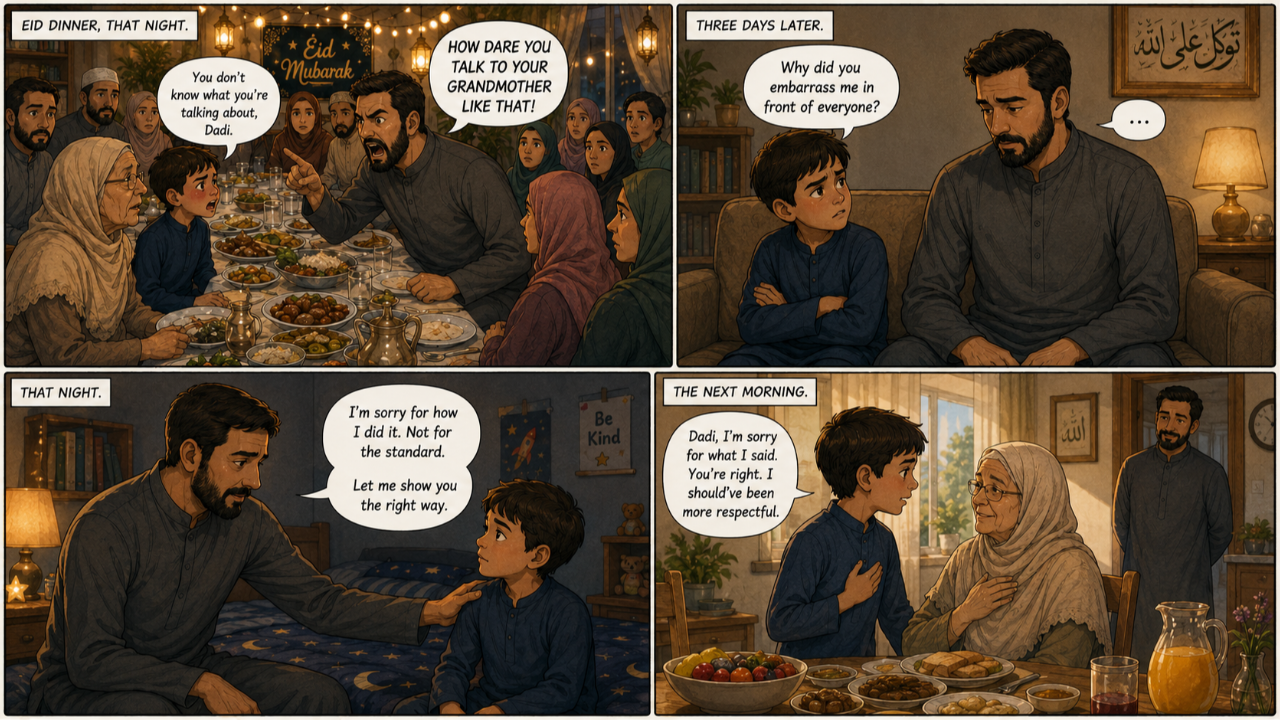
It was Eid dinner. Extended family. Thirty people in the house. Hassan's 8-year-old son Bilal said something disrespectful to his grandmother, in front of everyone. Hassan felt the eyes. He corrected Bilal loudly, sharply, immediately. In front of the room.
TEACHING
Bilal went red. Then went silent. Then disappeared into the back of the house for the rest of the evening.
Hassan's grandmother was defended. The room moved on. But three days later, Bilal still wasn't speaking to his father in the same way. And in a quiet moment, he said: "Why did you embarrass me in front of everyone?"
Hassan had been asking himself the same question.
The correction itself was warranted. The behavior was not acceptable. But the method, public, immediate, sharp, had done something that no correction should ever do: it had damaged the relationship more than it had redirected the behavior.
In the OMP framework, the Coach pillar is not about whether to correct. It is about how to correct so that the lesson actually lands.
And one of the most important rules of coaching is this: public correction produces public shame, not private growth. A child corrected in front of an audience is focused on one thing, the audience, not the lesson. They are managing embarrassment. They are not learning.
The most effective corrections are private, specific, regulated, and followed up.
Private: take them out of the room. "Come here for a second." Immediate doesn't mean public.
Specific: name the behavior, not the character. "What you said to Grandma was disrespectful", not "you're being disrespectful."
Regulated: if you're angry, they feel the anger more than the lesson. Pause. Lower your voice. Lead with calm.
Followed up: come back later, when the situation has passed, and close the loop. "Do you understand why what happened wasn't okay? What will you do differently?"
Hassan went to Bilal's room that night. He apologized for the method. He did not apologize for the standard, Bilal still needed to apologize to his grandmother. But he separated the what from the how.
Bilal apologized to his grandmother the next morning. Voluntarily. He brought it up himself.
The correction that works is not always the correction that feels most satisfying in the moment.
THIS WEEK'S APPLICATION
"This week, think of a recent correction that didn't land the way you hoped. Ask yourself: was it private or public? Was it about the behavior or the character? Was I regulated? What would I do differently? Then, if the situation is still open, go back and close the loop."
👉 JOIN THE OUTSTANDING MUSLIM PARENTS NEWSLETTER
(Join 5,000+ parents learning how to lead with clarity instead of control.)
— Coach Nazir, Founder of Outstanding Muslim Parents

